Writer Adam Wernick
Producer Becky Fogel
October 03, 2014 · 12:00 PM EDT
243
facebooktwittergoogleplusshare
MAVEN-Artist-Concept-Mars-Arrival-full.jpg

Credit: NASA
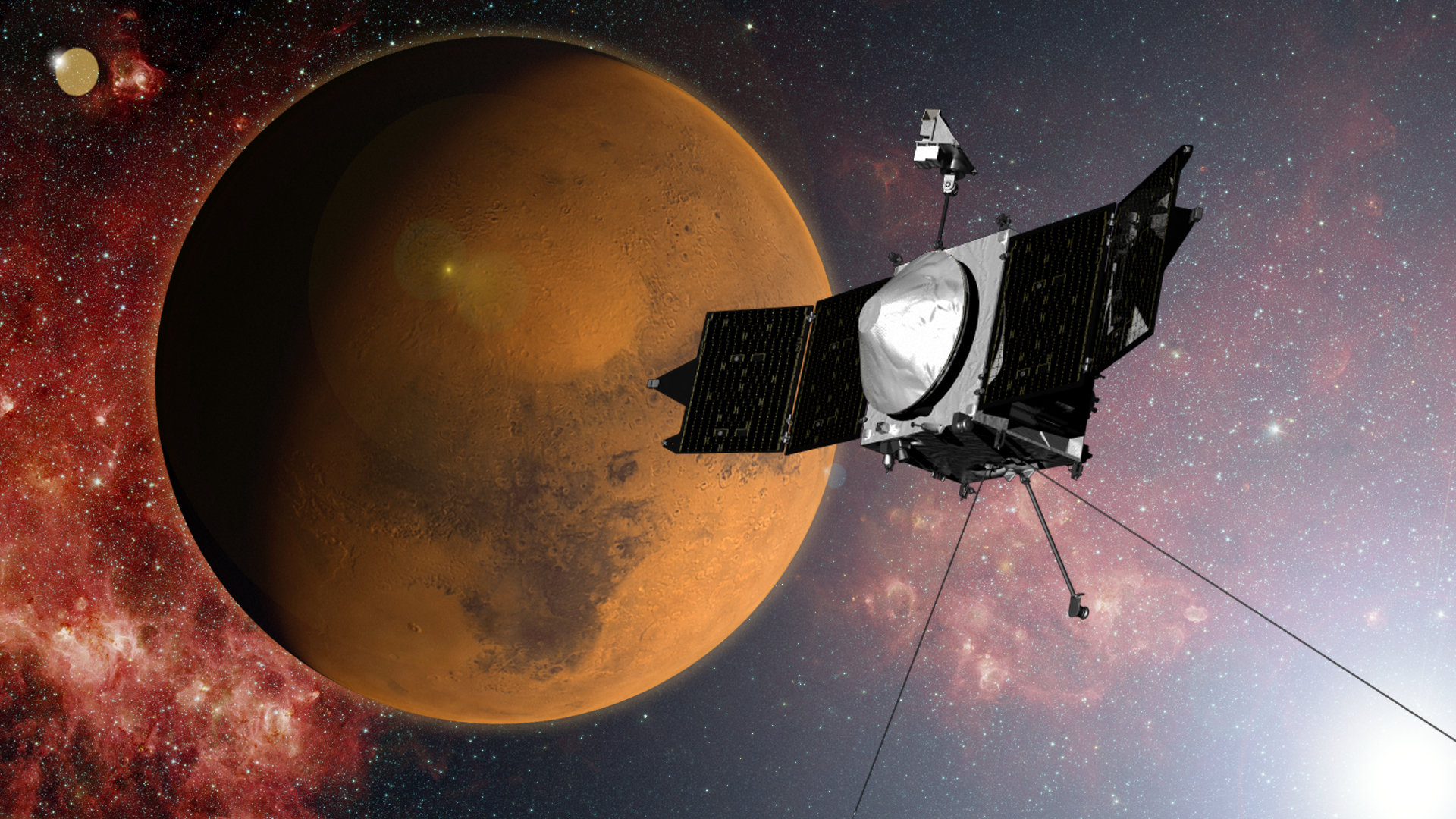
An artist's concept of NASA's MAVEN spacecraft approaching Mars. The probe entered Mars orbit on September 21.
NASA's latest Mars probe entered the planet's orbit on September 21. By sheer luck, it arrived just in time to get an up close look at Siding Spring, a comet set to pass by Mars on October 19.
Player utilities
00:00
00:00
(This story is based on a radio interview. Listen to the full interview.)
It's a little bit like space nerd Christmas. "This is at least a once-in-a-century event — and maybe a once-in-a-millennium or even a once-in-a-million year event — to have a comet pass so close to the atmosphere of another planet,” says David Brain, an assistant professor of astrophysical and planetary sciences at the University of Colorado.
Brain is also a co-investigator on the mission, which is called the Mars Atmosphere and Volatile Evolution mission, or MAVEN. He says the MAVEN team is "incredibly excited" by the unexpected comet viewing. MAVEN’sprimary mission is to try to understand how and why Mars’ atmosphere changed in the past four billion years, and Siding Spring's flyby may prove useful in doing so.
The comet will pass about 138,000 kilometers away from Mars, a considerable distance away for a planet that is only about 7,000 kilometers across. “But comets have really big tails, and comets also have enormous atmospheres,” Brain explains. “The hydrogen coma [the halo of gas surrounding] the comet, could extend for hundreds of thousands of kilometers, or maybe even a million kilometers. It could be that we truly witness two atmospheres in the solar system colliding with one another or interacting with one another."
MAVEN will collect data on the atmosphere around Mars for a few days before and after the comet arrives. “Comparing before and after observations will tell us how the atmosphere has responded,” Brain says.
One of the big puzzles about the Martian atmosphere is that observational evidence, like photos of dried-up riverbeds, shows that water once existed on the planet’s surface in a liquid state. But the atmosphere on Mars today is thin and cold, giving liquid water pretty much no chance to survive.
“Water can only exist [on Mars] as a liquid in certain regions near the equator and then maybe only for a few minutes or a few hours at a time,” Brain says. “Certainly not long enough to account for the formation of riverbeds.” So where did the water go? Where did the atmosphere go?
Brain says there are really only two answers: a particle in the atmosphere can go down and be absorbed into the surface; or it can go up and escape away into space. MAVEN is focused on the "ups:" What can give atmospheric particles enough energy to escape the gravity of the planet? Could Mars actually have lost its atmosphere into space?
The passing comet may provide important clues. “The gas and dust particles from the comet have energy as they enter Mars’ atmosphere,” Brain explains. “When they collide with the atmospheric particles there, they can heat up the Martian atmosphere and give those particles enough energy to perhaps escape. [We may see] if escape is an important process when things like comets go whizzing by.”
When the comet was discovered in early 2013, there was concern that MAVEN could be hit or damaged by dust from the comet. Scientists now believe the danger is low. But they still plan to "hide" MAVEN behind Mars during the comet’s closest approach — before they attempt any scientific observations.
India’s Mars Orbiter Mission, which arrived just days after MAVEN and has already sent back dramatic images, may also provide useful data. “Mars is getting a little bit crowded,” Brain says with a laugh. "[W]e're extremely happy that they have arrived at Mars with their mission. They have five science instruments on board, and at least two or three of those science instruments will be able to make measurements of the Martian atmosphere that could provide useful comparisons between the MAVEN team and the MOM team.”
MAVEN’s original science mission will proceed for one Earth year, starting in November of this year, Brain says. After that, they will have to ask NASA for funding to continue their observations. “However, the spacecraft is in really great health,” Brain says. “It has a lot of fuel on board. It could survive, we think, until at least the mid-2020’s.”
This story is based on an interview that aired on PRI's Science Friday with Ira Flatow
In Science, Tech & Environment and Science.
Tagged: David Brain spaceflight mars Exploration of Mars science
Related stories
Plans to put a human on Mars are a mess, says a new report. Should we even try?
July 07, 2014
India's low-budget Mars probe snaps an iconic photo of the red planet
September 30, 2014
What would life on Mars be like? A Canadian scientist spent months in a NASA-built dome to find out
July 30, 2014
Women are the face of India's Mars mission, but they're still the exception
September 26, 2014
NASA video says this is how Mars might once have looked
November 14, 2013

Adam Wernick is a freelance writer and a theater composer in St. Paul, Minnesota.

Becky Fogel is Science Friday's production assistant.
243
facebooktwittergoogleplusshare
Comments
Login

0 Comments
SortSubscribeRSS
NewestStoriesMostCommentedMostShared
How air conditioning got Ronald Reagan elected president
October 04, 2014
Forest ecologists are working to make New York's concrete jungle a little greener
October 04, 2014
How a New York court got to dictate terms to a entire country
October 03, 2014
Liberian Americans react to Ebola — and hostility — with ramped-up aid efforts
October 03, 2014
Want to host the 2022 Winter Olympics? We have just a few rules ...
October 03, 2014

Want to host the 2022 Winter Olympics? We have just a few rules ...
The_Reagans_waving_from_the_limousine_during_the_Inaugural_Parade_1981.jpg

How air conditioning got Ronald Reagan elected president

The campaign against ISIS isn't producing big victories

Government supporters destroy protest camps in Hong Kong

Why do we celebrate goddesses, but treat our women so poorly?
New York city street trees 1_o.jpg

Forest ecologists are working to make New York's concrete jungle a little greener
Want to host the 2022 Winter Olympics? We have just a few rules ...
The_Reagans_waving_from_the_limousine_during_the_Inaugural_Parade_1981.jpg
How air conditioning got Ronald Reagan elected president

Major funding provided by:


Arts, Culture & MediaBusiness, Finance & EconomicsConflict & JusticeDevelopment & EducationGlobal PoliticsHealth & MedicineLifestyle & BeliefScience, Tech & EnvironmentSports
About PRIContact usMeet the PRI.org TeamDonateSponsorshipPrivacy policyTerms of use
©2013 Public Radio International







No comments:
Post a Comment